
Free preview · full pattern in the Heirloom Doilies & Tablecloths
Lily of the Valley Tablecloth (1948): vintage crochet pattern
A fine lace tablecloth of 567 small square motifs, each worked from a treble-crochet centre ring. The printed cloth measures about 63 × 81 inches without the edge. Originally published as "Lily of the Valley Tablecloth" in New Tablecloths (Star Book No. 57) by American Thread Company in 1948, it is now in the public domain.
By the crochetpatterns.io editorial team · Reviewed · Editorial policy
By the crochetpatterns.io editorial team · Reviewed September 14, 2026 under our editorial policy · pattern testing in progress
| Detail | Value |
|---|---|
| Skill level | Advanced |
| Yarn weight | Lace (#0) |
| Yardage | 10800–12000 yd (9876–10973 m) |
| Hook | 1 mm |
| Gauge | Not given in the original — work to the printed finished size (see pattern). |
| Finished size | Not printed |
| Time | about 4 hours |
Materials
- Size 30 mercerized crochet cotton (printed: Star Article 20, Size 30, or Gem Article 35, Size 30)
- Yardage: 36 balls × 325 yd = about 11,700 yd (or 30 balls × 400 yd = about 12,000 yd) of size 30 cotton, as printed
- Tapestry needle, rustproof pins and starch for blocking
- Hook: Start with a 1.0 mm (US 12) steel hook — the printed size is #12 — and change size so one motif measures about 3 inches.
Abbreviations (US terms)
Notes before you start
- Source: "Lily of the Valley Tablecloth", New Tablecloths (Star Book No. 57), American Thread Company, 1948. Public domain in the USA.
- As printed — materials: AMERICAN THREAD COMPANY; “STAR” MERCERIZED CROCHET COTTON.; ARTICLE 20. SIZE 30; 36—325 yd. Balls White, Ecru or Cream or “Gem” Mercerized Crochet Cotton, Article 35, Size 30. 30—400 yd. Balls. Steel Crochet Hook #12. Each motif measures about 3 inches. 567 motifs 21×27 are required for cloth measuring about 63×81 inches without edge.. Gauge: Not given.
- Modernisation note: Transcribed from the original publication; stitches, repeats and their order are unchanged.
- Modernisation note: Run-on paragraphs split into one round, row or step per line.
- Modernisation note: The source leaflets already use US crochet terms; only abbreviations and wording were modernised.
- Modernisation note: “tr c” → “tr”
- Modernisation note: “d c” → “dc”
- Modernisation note: Round/row labels rewritten in modern form (e.g. “2nd Round.” → “Rnd 2:”, “7th to 10th rnds incl:” → “Rnds 7–10:”)
- Modernisation note: “s c” → “sc”
- Modernisation note: “break thread” → “fasten off”
- Modernisation note: Page numbers, page-continuation notes and illustration references removed.
- Modernisation note: No gauge is printed. Suggested check: work to the printed finished size (see the pattern) and change hook size if your piece is noticeably larger or smaller.
- Modernisation note: Stitch counts have not been added; where the original prints a count it is kept as printed.
Motif
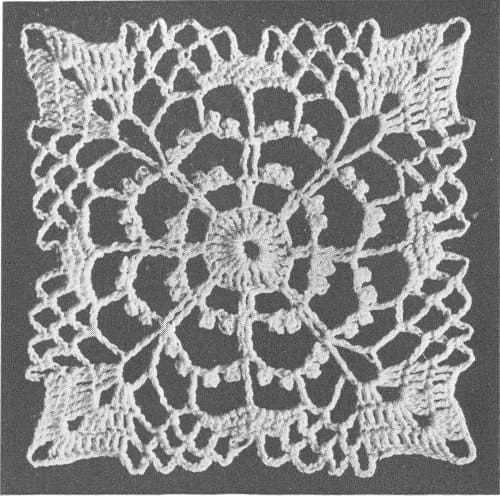
- Ch 8, join to form a ring, ch 4 and work 23 tr into ring, join in 4th st of ch.
- Row 2: Ch 3, dc in same space, * ch 6, sl st in 5th st from hook for picot, ch 6, sl st in 5th st from hook for picot, ch 1, skip 2 tr, 2 dc in next tr, repeat from * 6 times, * ch 6, sl st in 5th st from hook for picot, repeat from *, ch 1, join in 3rd st of ch.
- Row 3: Ch 4, tr in dc, * ch 6, sl st in 5th st from hook for picot, repeat from * 3 times, ch 1, 1 tr in each of the next 2 dc, repeat from 1st * all around in same manner, join in 4th st of ch.
- Row 4: Ch 10, * tr in center of 4 picot loop, ch 6, tr between next 2 tr, ch 6, tr in same space, ch 6, tr in center of next 4 picot loop, ch 6, tr between next 2 tr, ch 6, repeat from * twice, tr in center of next 4 picot loop, ch 6, tr between next 2 tr, ch 6, tr in same space, ch 6, tr in center of next 4 picot loop, ch 6, join in 4th st of ch.
- Row 5: Ch 1, 6 sc over loop, ch 5, sc in next loop, ch 5, 3 dc in next loop, ch 3, 3 dc in same loop, * ch 5, sc in next loop, ch 5, 6 sc over each of the next 2 loops, ch 5, sc in next loop, ch 5, 3 dc in next loop, ch 3, 3 dc in same loop, repeat from * twice, ch 5, sc in next loop, ch 5, 6 sc over next loop, join in 1st sc.
- Row 6: Ch 1, 1 sc in each of the next 4 sc, * ch 5, sc in next loop, repeat from * once, ** ch 5, 1 dc in each dc, 3 tr in corner loop, ch 3, 3 tr in same space, 1 dc in each dc, * ch 5, sc in next loop, repeat from *, ch 5, skip 2 sc, 1 sc in each of the next 8 sc, * ch 5, sc in next loop, repeat from * once, then repeat from ** all around in same manner ending row with skip 2 sc, 1 sc in each of the next 4 sc, join in 1st sc.
- Row 7: Ch 1, 1 sc in each of the next 2 sc, * ch 5, sc in next loop, repeat from * twice, ** ch 5, 1 dc in each of the next 6 sts, 3 tr in corner loop, ch 5, 3 tr in same loop, 1 dc in each of the next 6 sts, * ch 5, sc in next loop, repeat from * twice, ch 5, skip 2 sc, 1 sc in each of the next 4 sc, * ch 5, sc in next loop, repeat from * twice, then repeat from ** all around in same manner, join in 1st sc, fasten off.
- Work a 2nd motif in same manner joining to 1st motif in last row as follows: ch 1, 1 sc in each of the next 2 sc, * ch 5, sc in next loop, repeat from * twice, ch 5, 1 dc in each of the next 6 sts, 3 tr in corner loop, ch 2, sl st in corresponding loop of 1st motif, 3 tr in same loop of 2nd motif, 1 dc in each of the next 6 sts, * ch 2, sl st in corresponding loop of 1st motif, ch 2, sc in next loop of 2nd motif, repeat from * twice, ch 2, sl st in corresponding loop of 1st motif, ch 2, skip 2 sc of 2nd motif, 1 sc in each of the next 4 sc, * ch 2, sl st in corresponding loop of 1st motif, ch 2, sc in next loop of 2nd motif, repeat from * twice, ch 2, sl st in corresponding loop of 1st motif, ch 2, 1 dc in each of the next 6 sts of 2nd motif, 3 tr in corner loop, ch 2, sl st in corresponding loop of 1st motif, ch 2, 3 tr in same loop of 2nd motif and complete motif same as 1st motif. join 3rd motif to 2nd motif and 4th motif to 1st and 3rd motifs in same manner.
- EDGE: With right side of work toward you and starting at corner motif, join thread in center of sc group to the right of corner, * ch 5, sc in next loop, repeat from * 3 times, ch 5, skip 4 dc, sc in next dc, ch 5, 3 tr in corner loop, ch 5, 3 tr in same loop, ** ch 5, skip 3 tr and 1 dc, sc in next dc, * ch 5, sc in next loop, repeat from * 3 times, ch 5, sc in center of sc group, * ch 5, sc in next loop, repeat from * 3 times, ch 5, skip 4 dc, sc in next dc, * ch 5, sc in next loop, repeat from *, then repeat from ** all around working all corners in same manner, join.
- Row 2: Sl st to center of loop, ch 8, sl st in 5th st from hook for picot, dc in next loop, * ch 5, sl st in 5th st from hook for picot, dc in next loop, repeat from * twice, * ch 5, sl st in 5th st from hook for picot, ch 6, sl st in 5th st from hook for picot, dc in next loop, repeat from * once, ch 5, sl st in 5th st from hook for picot, ch 6, sl st in 5th st from hook for picot, repeat from * once, dc in same loop (corner), * ch 5, sl st in 5th st from hook for picot, ch 6, sl st in 5th st from hook for picot, dc in next loop, repeat from * once, ch 5, sl st in 5th st from hook for picot, dc in next loop, repeat from * 10 times, ch 5, sl st in 5th st from hook for picot, dc in same loop, ** ch 5, sl st in 5th st from hook for picot, dc in next loop, * ch 5, sl st in 5th st from hook for picot, dc in next loop, repeat from * 11 times, ch 5, sl st in 5th st from hook for picot, dc in same loop, repeat from ** all around working all corners same as 1st corner.
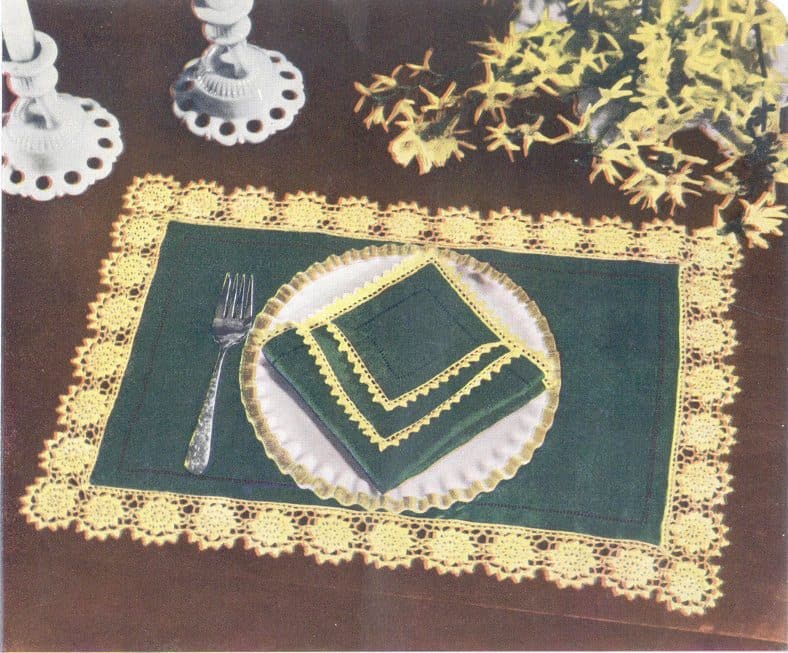
- If napkins are desired, cut linen the size required. Turn under a small hem. Work a row of sc all around.
- Row 2: Ch 7, sl st in 5th st from hook for picot, ch 2, skip 3 sc, sc in next sc, repeat from beginning all around.
Errata
No corrections have been published for this pattern. Found a mistake? Tell us and we will log the fix here with a date.
Frequently asked questions
Where is the Lily of the Valley Tablecloth pattern from?
It was published as "Lily of the Valley Tablecloth" in New Tablecloths (Star Book No. 57) by American Thread Company in 1948. The publication is in the public domain in the United States; this version is transcribed and modernised by crochetpatterns.io.
What yarn or thread do I need for the Lily of the Valley Tablecloth?
Size 30 mercerized crochet cotton. 36 balls × 325 yd = about 11,700 yd (or 30 balls × 400 yd = about 12,000 yd) of size 30 cotton, as printed
What hook should I use?
Start with a 1.0 mm (US 12) steel hook — the printed size is #12 — and change size so one motif measures about 3 inches. Gauge: Not given in the original — work to the printed finished size (see pattern).