
Free preview · full pattern in the Vintage Afghans & Bedspreads
Crocheted Afghan with Daisy Trim (vintage Crazy Daisy): vintage crochet pattern
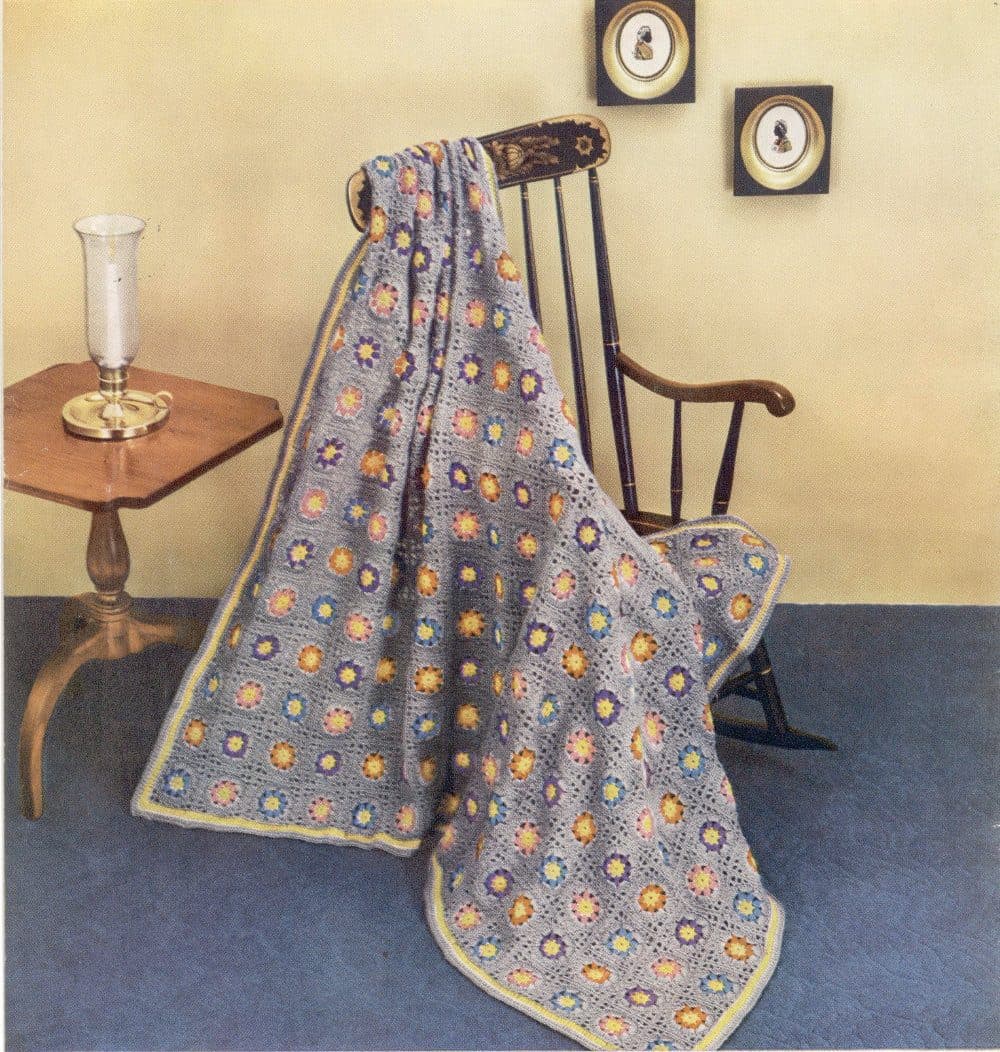
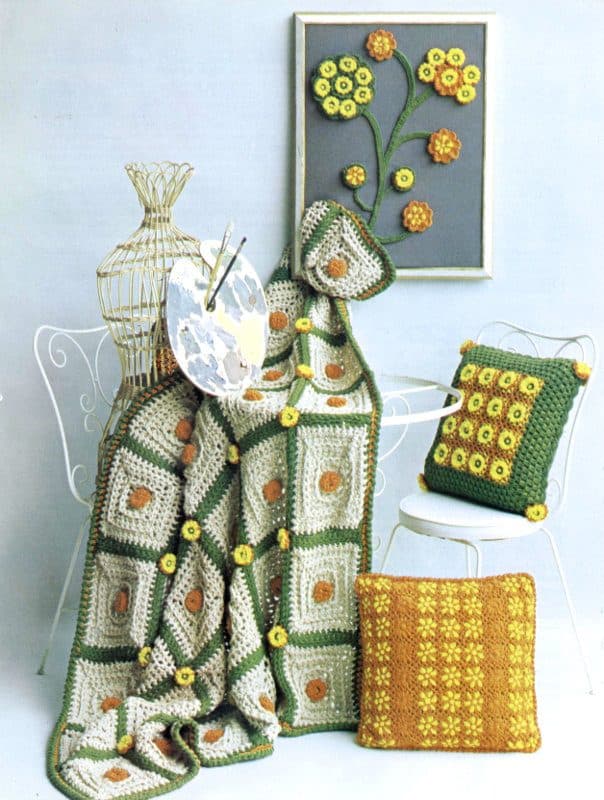
An afghan of 42 ridged single crochet squares worked with three strands of beige worsted, each with a fluffed orange daisy sewn to the center and orange-and-maize daisies sewn at the joinings, edged in orange and loden green. Originally published as "Crocheted Afghan with Daisy Trim" in "Crazy Daisy" Boutique, Vol. No. 5 by Scovill Manufacturing Company (Dritz.
By the crochetpatterns.io editorial team · Reviewed · Editorial policy
By the crochetpatterns.io editorial team · Reviewed September 14, 2026 under our editorial policy · pattern testing in progress
| Detail | Value |
|---|---|
| Skill level | Easy |
| Yarn weight | Medium (#4) |
| Yardage | 3960–4400 yd (3621–4023 m) |
| Hook | 15.75 mm |
| Gauge | As printed: each square approx. 9 × 9 in (23 × 23 cm), worked with 3 strands held together. |
| Finished size | Approx. 55 × 64 in (140 × 163 cm) |
| Time | about 8 hours |
Materials
- Crazy Daisy winder or similar daisy loom (the book describes the regular winder as making daisies up to 2 in / 5 cm).
- Worsted (#4) yarn in 4 oz (113 g) skeins: 16 beige (A), 3 loden green (B), 2 orange (C), 1 maize (D) = 88 oz (2,495 g). The squares and edging are worked with 3 strands held together, which behaves like a jumbo (#7) yarn.
- Yardage: not printed. Assuming about 200 yd per 4 oz, which is typical of worsted (an assumption — check your label): A about 3,200 yd (2,926 m), B about 600 yd (549 m), C about 400 yd (366 m), D about 200 yd (183 m).
- Original hooks: HERO No. Q crochet hook (squares) and No. K aluminum crochet hook (outer trim).
- Trim hook: start with 6.5 mm (US K-10½).
- Yarn darning needle.
- Hook: Start with 15.75 mm (US Q) and change size to match the gauge.
Abbreviations (US terms)
Notes before you start
- Source: "Crocheted Afghan with Daisy Trim", "Crazy Daisy" Boutique, Vol. No. 5, Scovill Manufacturing Company (Dritz Division). Public domain in the USA.
- As printed — materials: HERO Crazy Daisy Winder.; 4 Ply Knitting Worsted, 4 oz. skein, 16 Beige (A), 3 Loden Green (B), 2 Orange (C) and 1 Maize (D).; HERO No. Q crochet hook and No. K aluminum crochet hook.; Yarn darning needle.. Gauge: Each square approx. 9″ x 9″..
- Modernisation note: The "Making the daisies" section is the book's general "To Make Daisies" directions (printed once near the front and referenced by this pattern as "see page 3"); it is transcribed here so the pattern is complete.
- Modernisation note: The Crazy Daisy winder is a 12-spoke flower loom; the book describes the regular winder as making daisies up to 2 in (5 cm) and the King Size winder up to 3 in (8 cm). Any similar daisy loom of the right size can be used.
- Modernisation note: The original is written in US terms; "attach" is written as "join".
- Modernisation note: "Pick up the 2 loops of each st" / "pick up both loops of each st" is written as "work through both loops of each st".
- Modernisation note: Corrected an obvious printing error in rnd 5: the original reads "1 sc in back loop of next 8 sc, 3 sc in back loop of next st (corner); repeat from *" with no asterisk printed; an asterisk was placed before "1 sc in back loop" to match rnds 3 and 4.
- Modernisation note: The 30 orange-maize daisies fit 5 joining points across each of the 6 inner joining rows of a 6 × 7 layout; this is our arithmetic, not printed.
- Modernisation note: Check: the outer trim is worked with 3 strands on the No. K hook, a much smaller hook than the No. Q used for the squares; kept as printed.
- Modernisation note: "Working backwards (counter clockwise)" is kept as printed; in modern terms this edge is worked in the reverse direction, in the manner of reverse single crochet.
- Modernisation note: The book gives skein weights but not yardages; the yardage ranges given are stated assumptions for typical yarns of that weight — check your label.
- Modernisation note: "(see page 3)" is pointed to the "Making the daisies" section on this page.
- Modernisation note: Check: the book gives no year of publication.
- Modernisation note: Metric conversions were added; they are not in the original.
Making the daisies (from the book's general directions)
- These directions can be used for the regular Crazy Daisy winder and for the King Size Crazy Daisy winder.
- A: Hold winder in left hand with flat side in palm of hand. Turn knob to release spokes (see illustration A).
- B: Turn winder over with knob underneath and flat side with spokes extended facing you. Hold winder in left hand. With left thumb hold yarn at center leaving end to extend about 1 in (2.5 cm); with right hand, pass yarn from left to right around spoke No. 1; then across center from right to left around spoke No. 2 directly opposite.
- Wrap around these 2 spokes once more in the same manner, or as many times as desired (the number of wraps depends upon the thickness of the yarn you will be using).
- Bring yarn across center and wind from left to right around spoke No. 3; then across center from right to left around spoke No. 4. Wrap around these 2 spokes once more, or as many times as you wrapped around spoke 1 and 2.
- Bring yarn across center and wind from left to right around spoke No. 5; then across center and from right to left around spoke No. 6. Wrap around these 2 spokes once more or as many times as you wrapped around spoke 1 and 2.
- Continue in this manner to wrap yarn around 2 spokes directly opposite each other and then passing onto the next 2 spokes until all spokes are wrapped, ending with spoke No. 12. Bring yarn across center and cut leaving 1 in (2.5 cm) extended beyond center (see illustration B). Do not remove from winder.
- C: Center: Thread tapestry needle with yarn. The side facing you will be the wrong side of the daisy. Fasten at center of wrong side as for embroidery.
- Insert needle under 4 petals and draw yarn through; bring yarn back over last 3 of the 4 petals; insert needle under these 3 petals plus 1 more, making 4 petals in all; draw yarn through.
- Continue in this manner to bring yarn back 3 petals and then draw it under 4 petals each time until you have made 13 sts. Be sure to have 13 sts or center will be incomplete.
- As the center sts are worked, weave around the starting end of daisy for a few sts to fasten it securely. Fasten on wrong side. Cut ends (see illustration C). Turn knob to draw in spokes and release daisy.
- D: Right side of daisy (see illustration D).
Continue this pattern
The rest of the Crocheted Afghan with Daisy Trim (vintage Crazy Daisy) pattern is in the Vintage Afghans & Bedspreads
Still to come in the full pattern:
- Daisies
- Crocheted square
- Finishing
Included with 28 patterns for $19 — $0.68 per pattern.
Errata
No corrections have been published for this pattern. Found a mistake? Tell us and we will log the fix here with a date.
Frequently asked questions
Where is the Crocheted Afghan with Daisy Trim pattern from?
It was published as "Crocheted Afghan with Daisy Trim" in "Crazy Daisy" Boutique, Vol. No. 5 by Scovill Manufacturing Company (Dritz Division). The publication is in the public domain in the United States; this version is transcribed and modernised by crochetpatterns.io.
What yarn or thread do I need for the Crocheted Afghan with Daisy Trim?
medium (worsted) (#4) yarn. Original: 22 skeins of 4 oz worsted (16 A, 3 B, 2 C, 1 D). Yardage per skein not printed (about 200 yd per 4 oz assumed, about 4,400 yd in total — check your label).
What hook should I use?
Start with 15.75 mm (US Q) and change size to match the gauge. Gauge: As printed: each square approx. 9 × 9 in (23 × 23 cm), worked with 3 strands held together.